How to Use a Gaiwan: From Practice Pour to Cleanup
To use a gaiwan for brewing, hold the lid slightly open to strain the leaves while pouring the tea into a receiving cup or pitcher. Begin by practising with cool water. Before lifting the bowl, check that its saucer is clean and separates freely: a good pour starts before your wrist moves.
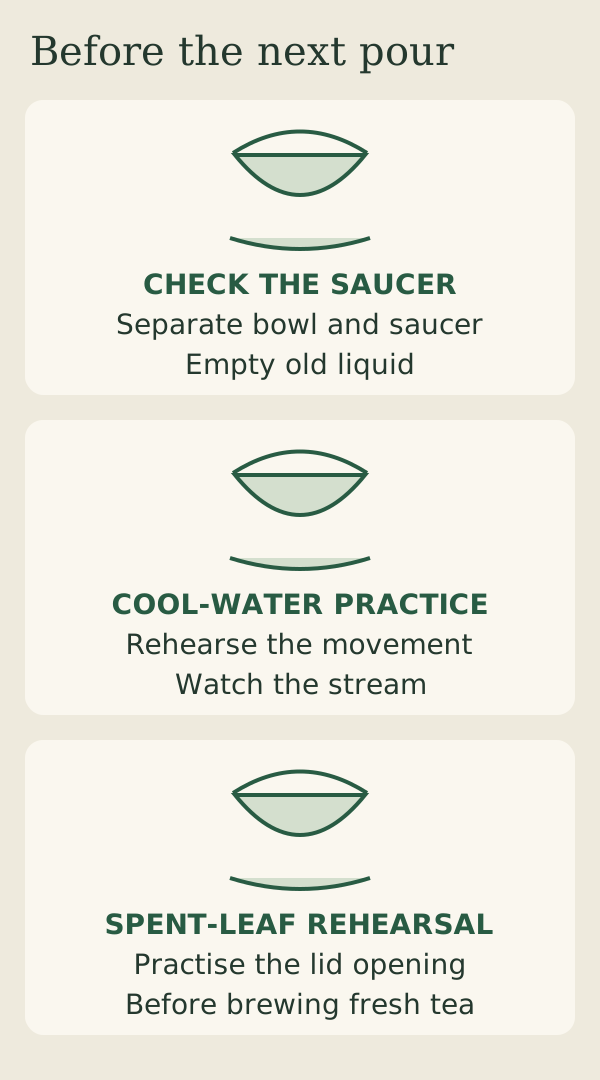
Check underneath before picking it up
Dried tea can make a saucer stick to the bowl and then drop when you lift it. Separate the pieces while they are still on the table and remove any sticky residue before starting.
Look for old liquid in the saucer, too. If you lift and tip the whole assembly, that liquid can join the fresh tea. Empty and clean the saucer rather than treating it as a permanently attached base.
Bowl-and-saucer fit varies. If you plan to lift them together, check how securely your particular bowl sits on its saucer; do not assume another set will balance the same way.
Rehearse the movement without brewing
Use cool water to practise lifting, pouring and setting the gaiwan down. Keep the practice separate from making tea.
For a rim grip, place your thumb and middle finger on opposite sides of the rim and secure the lid with your index finger. Try resting that finger across the lid knob rather than pushing the fingertip into its hollow. If the grip hurts or feels insecure, set the vessel down; do not force the pour.
Watch the direction of your movement. An unintended sideways tilt towards your body can send tea off course and towards your fingers. In a cool-water rehearsal, aim into the receiving vessel and practise tipping along a single axis rather than adding that sideways turn.
Spent leaves can be used for a separate pouring rehearsal before brewing fresh tea. This lets you practise the lid opening with leaves present, instead of only repeating an empty-bowl pour.
After practising, revisit a demonstration and compare it with what you actually did. Notice the position of your hand and lid rather than only watching the finished stream.
For help choosing a bowl that fits your hand, see our porcelain gaiwan guide.
Make the tea
Warm the gaiwan with hot water and discard that water. Add your tea and follow its brewing instructions for leaf quantity, water temperature and steeping time; there is no single recipe that fits every tea.
Leave room below the rim instead of filling to the brim. Adjust the lid opening so water can escape while the leaves are held back. A very narrow opening can slow the pour, while small leaf fragments may escape through a wider opening.
When the infusion is ready, pour it into your cup or pitcher. Empty the brewing bowl fully so the leaves are not left sitting in the remaining tea. Repeat with fresh water while the leaves still produce a brew you enjoy.
Keep this check beside the tea tray
| Moment | Check |
|---|---|
| Before lifting | The saucer separates freely and contains no old liquid. |
| During cool-water practice | The pour aims into the receiving vessel without an unintended sideways turn. |
| When setting the lid | Your finger controls the knob without being pushed into its hollow. |
| When adding leaves | Rehearse with spent leaves if the lid opening still needs practice. |
| After pouring | The brewing bowl is drained, rather than continuing to steep in leftover tea. |
Finish with the pieces apart
Rinse the gaiwan after the session and let it dry. Before the next use, check the bowl and saucer separately for residue and retained liquid. Do not let yesterday's tea become an unexpected part of today's pour.